
Free chapter
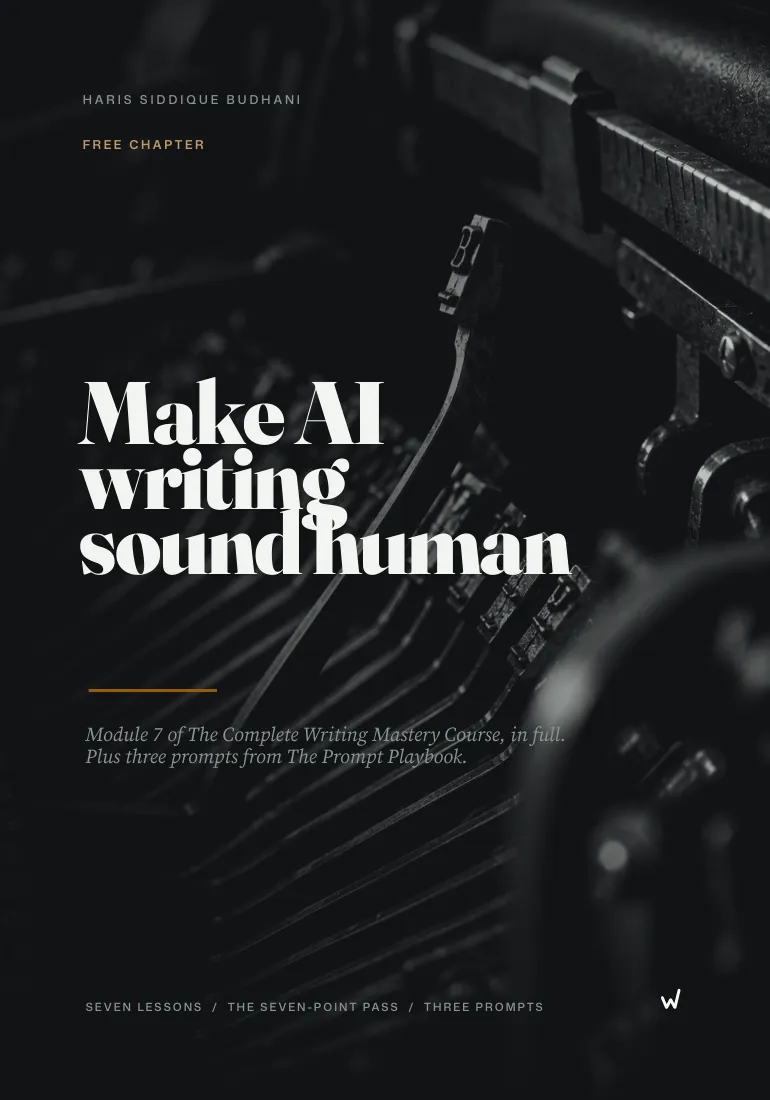
Module 7 of the Writing Mastery Course, complete and free, with three prompts from The Prompt Playbook.
To make AI writing sound human, hand the model the generative work and keep the judgment yourself: rewrite the opening, delete robotic transitions, replace vague quantities with specifics, break the rhythm, add one human element per section, rewrite the close and read the draft aloud. This free chapter walks through each step.
- Module 7 of the Writing Mastery Course, in full
- The nine patterns found in almost every unedited AI draft
- Three prompts from The Prompt Playbook, including the Prompt Improver
- 7
- lessons in the module
- 9
- patterns of machine writing
- 7
- points in the humanization pass
- 3
- bonus prompts
Why AI Writing Sounds Like Nobody in Particular
AI produces technically correct writing that sounds like nobody in particular. The patterns repeat, and once you know them you can't unsee them.
- Every section runs the same length, and every paragraph has the same shape.
- Transitions come from one short list of formal connectors.
- Examples are generic and hypothetical, never named.
- Numbers are round and vague, where a real figure should be.
- Every claim is hedged, so nothing is committed to.
- The opening and the close use the same worn phrases as a thousand other drafts.
The Free Chapter Walks Through AI Writing From Start to Finish
Module 7 has seven lessons. Pick one to see what it covers and a passage from it.
- See which stages AI handles well and which it handles poorly.
- Know what to delegate and what never to delegate.
- Follow a full AI writing workflow, with a human at every judgment step.
- Spot the nine patterns of bad AI output in a draft.
- Run the seven-point humanization pass in order.
Lesson 1 of 7
Where AI helps and where it hurts
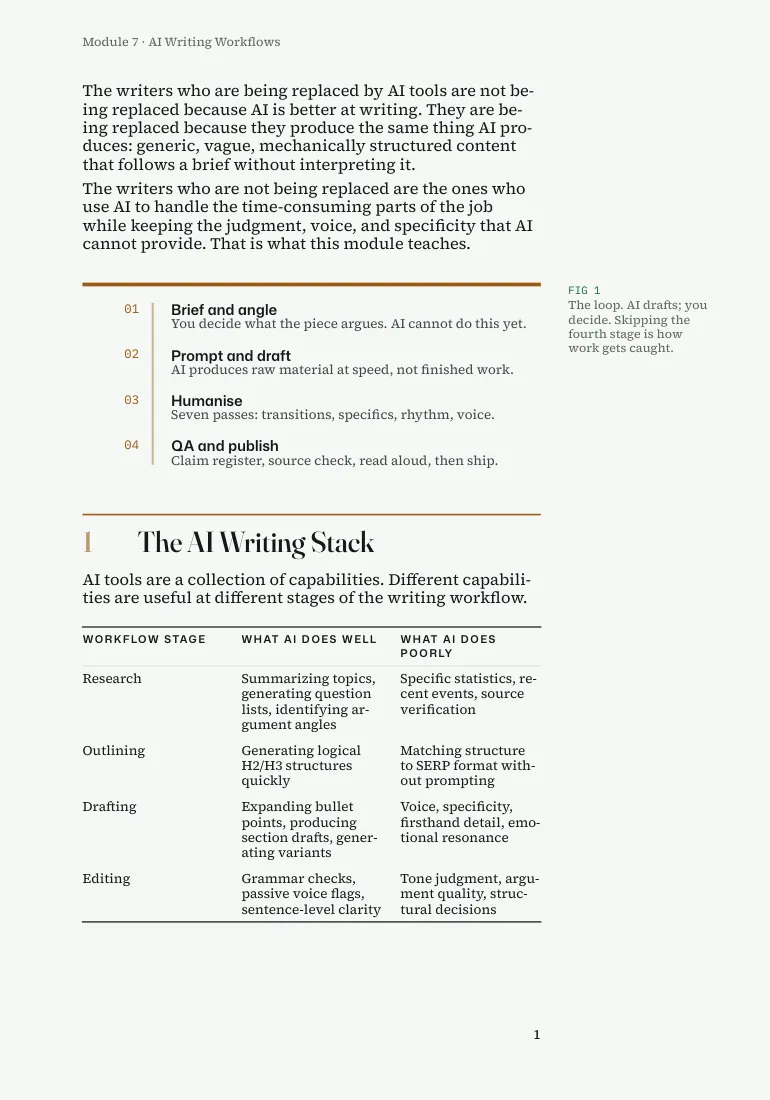
- AI does research summaries, outlines, section drafts and grammar checks well.
- It does specific statistics, structural fit, voice and tone judgment poorly.
- Match each stage of the workflow to the right worker.
The module · the stack, stage by stage
RESEARCH Good at summarizing topics, generating question lists and identifying argument angles. Poor at specific statistics, recent events and source verification.
DRAFTING Good at expanding bullet points, producing section drafts and generating variants. Poor at voice, specificity, firsthand detail and emotional resonance.
Lesson 2 of 7
What to hand to the model
- Repetitive, generative tasks where volume matters.
- Your judgment applies in the selection and refinement step.
- Never in the production step.
The module · what to delegate
THE PATTERN Delegate repetitive, generative tasks where volume matters and your judgment is applied in the selection and refinement step, not the production step.
Lesson 3 of 7
What you keep for yourself
- Fact verification, because AI states invented figures with full confidence.
- Voice and tone judgment.
- The specific angle, source evaluation and structural judgment.
The module · what never to delegate
FACT VERIFICATION AI fabricates statistics, invents citations and states outdated information with complete confidence.
THE ANGLE Deciding what the piece argues, what the hook is and what the close commits to are human decisions.
Lesson 4 of 7
A workflow with a human at every judgment step
- Brief, SERP review and the human edit are not the model's job.
- Research, outline and section drafts are.
- A humanization pass and a QA check come before publishing.
The module · the workflow
THE RULE This workflow produces clean output at speed. It uses AI for the stages where it adds time and human judgment for the stages where AI adds error.
Lesson 5 of 7
The nine patterns of bad AI output
- Same-length sections and same-shape paragraphs.
- Formal transitions, worn openers and closers.
- Generic examples, vague numbers and hedged claims.
The module · the test
THE TEST The nine patterns appear in almost every unedited AI draft. If you see three or more in a piece, the humanization pass is not optional.
Lesson 6 of 7
Seven checks, run in order
- Rewrite the opening and delete the robotic transitions.
- Replace vague quantities and break the rhythm.
- Add one human element per section, rewrite the close and read it out loud.
The module · points 1, 3 and 7
POINT 1 Rewrite the opening. If it starts with 'In today's…' or 'In this article…', delete it and start with the claim, a fact or a contradiction.
POINT 3 Replace vague quantities. For each one, use a specific number, a named example or a real case. If you cannot find one, delete the claim.
POINT 7 Read it out loud. Every place you stumble is a rewrite.
Lesson 7 of 7
What AI detectors measure, and what they don't
- Detectors score signals such as sentence uniformity and structural symmetry.
- They are imperfect: strong human writers sometimes get flagged.
- Treat the score as a secondary check, not the standard.
The module · a note on detection tools
THE GOAL The goal of the humanization pass is not to trick these tools. The goal is to write content that is genuinely human in structure, voice and specificity.
Watch the Machine Leave the Writing
In today's fast-paced digital world, businesses must leverage cutting-edge solutions to unlock their full potential.
Stock opener, vague claims, no specifics. It reads like a machine.
The same line, run through the seven-point humanization pass from Module 7. An illustration, not a detector reading.
Read the pages first
1 / 3
How to Humanize an AI Draft in Five Steps
Run the pass on every AI-assisted draft before the final check. Work through the points in order.
-
Mark the patterns
Read the draft once and mark every instance of the nine patterns of bad AI output. Three or more means the pass is not optional.
OUTPUT A marked-up draft.
-
Fix the opening and transitions
Rewrite the opening so it starts with the claim, a fact or a contradiction, and delete the robotic transitions.
OUTPUT A draft that starts with a point.
-
Replace the vague
Swap each vague quantity for a number, a named example or a real case, or delete the claim.
OUTPUT Specifics where there were gestures.
-
Break the rhythm
Break runs of similar-length sentences, vary list items and add one human element per section.
OUTPUT A draft that doesn't read in a monotone.
-
Close and read aloud
Rewrite the close with a specific recommendation, then read the whole draft out loud and rewrite every stumble.
OUTPUT A draft that sounds like a person wrote it.
What the Free Chapter Includes
- Module 7, complete
- All seven lessons of AI Writing Workflows from the Writing Mastery Course.
- The nine patterns of machine writing
- A checklist you can run on any draft in a few minutes.
- The seven-point humanization pass
- Seven ordered checks, from the opening to a read-aloud test.
- What detectors actually measure
- A plain account of why a detector score makes a poor editing target.
- An exercise with a scoring rubric
- Generate a 600-word AI draft, humanize it and grade the result.
- Three prompts from The Prompt Playbook
- Including the Prompt Improver, which rebuilds a rough prompt with 15 components.
- A free path to the full course
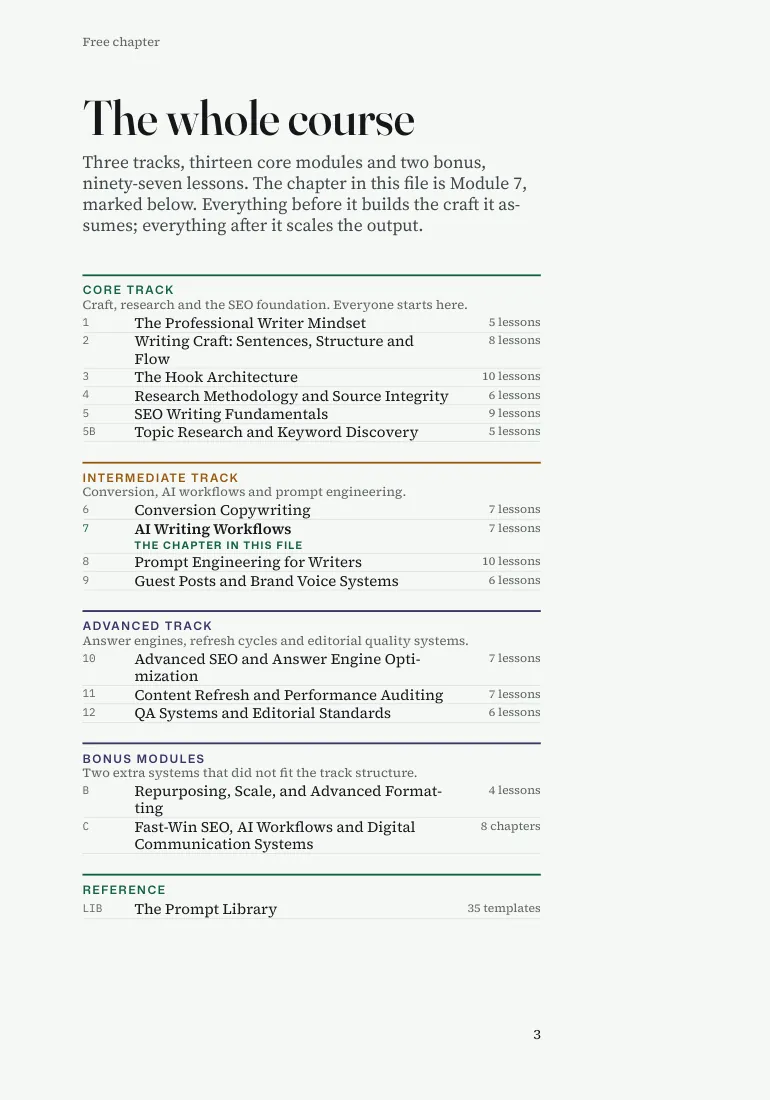
- Module 7 is one of 15 in the Writing Mastery Course.
Where to get the free chapter
| Store | Price | Includes |
|---|---|---|
| Whop | Free | Free chapter PDF and three prompts |
| Gumroad | Free | Free chapter PDF and three prompts |
Prices checked 10 October 2026. Each store shows its own refund terms at checkout.
What AI Detectors Can and Cannot Tell You
Tools such as Originality.ai and GPTZero score content on signals including sentence uniformity, vocabulary patterns and structural symmetry. The chapter's position is plain: do not write to the score.
Detection tools are imperfect. Strong human writers sometimes get flagged, and weak human writers sometimes pass. Writing quality is the standard, and the detection score is a secondary check.
And the chapter does not promise to beat any detector. It teaches you to fix the writing itself, which is the part you control.
How to Make AI Writing Sound Human: Frequently Asked Questions
What does it mean to make AI writing sound human?
It means removing the patterns that give machine writing away, such as uniform sections, formal transitions, generic examples and vague numbers, and adding what a person brings: a specific angle, named examples and a voice.
How do I make AI writing sound human?
Run the seven-point humanization pass: rewrite the opening, delete the robotic transitions, replace vague quantities, break the rhythm, add one human element per section, rewrite the close and read the draft aloud.
Can I humanize AI content for free?
Yes. This chapter is free, and the pass is a manual checklist that costs nothing to run. You can get it on Whop or Gumroad.
Can ChatGPT make its own writing sound human?
It can draft sections and suggest variants, but the chapter says some decisions stay with you: facts, voice, the specific angle, source choice and structural judgment.
Will this help me pass an AI detector?
Possibly, as a by-product, but that is not the goal. The chapter explains what detectors score, why they are imperfect and why a detector score is a poor editing target.
What are the nine patterns of bad AI output?
Same-length sections, formal transitions, worn openers, worn closers, generic examples, vague numbers, hedged claims, formulaic vocabulary and identical paragraph shapes. Three or more in a draft means the pass is not optional.
What is in the three bonus prompts?
They come from The Prompt Playbook and include the Prompt Improver, a meta-prompt that rebuilds a rough prompt using 15 components.
Is the chapter really free?
Yes. It's $0 on Whop. On Gumroad it is listed as pay what you want, with a minimum of zero.
More questions
Which AI tools does it apply to?
Any of them. The patterns and the pass describe the writing, not the tool, so they apply to ChatGPT, Claude, Gemini and the rest.
How long does the pass take?
It depends on the draft. The seven points are short, ordered checks, and the chapter's exercise has you run all seven on a draft of 600 words or more.
Does it cover Claude and ChatGPT prompts?
The chapter covers a workflow that uses prompts at the research, outline and drafting stages. The three bonus prompts come from the Playbook.
Where does this chapter sit in the course?
It is Module 7, in the Intermediate track, between conversion copywriting and prompt engineering.
Who wrote it?
Haris Siddique Budhani, who has worked in content and SEO since 2011, built content teams from scratch and trained more than 40 writers.
What should I read next?
If the pass helped, the full course covers research, SEO writing, conversion copy and QA. If you want prompts, the Playbook has 100 for marketing work.
Get the Free Chapter and Fix Your Next AI Draft
Haris Siddique Budhani wrote the chapter for people who edit AI drafts every week. Download it, run the seven-point pass on your next draft and see which patterns you were missing. It is free on both stores. The full course sits on the writing and SEO books shelf.
Want the prompts too? The Prompt Playbook has 100.