
The Complete Writing Mastery Course
97 lessons on SEO writing, conversion copy and making AI drafts sound human, with 35 prompt templates you can paste.
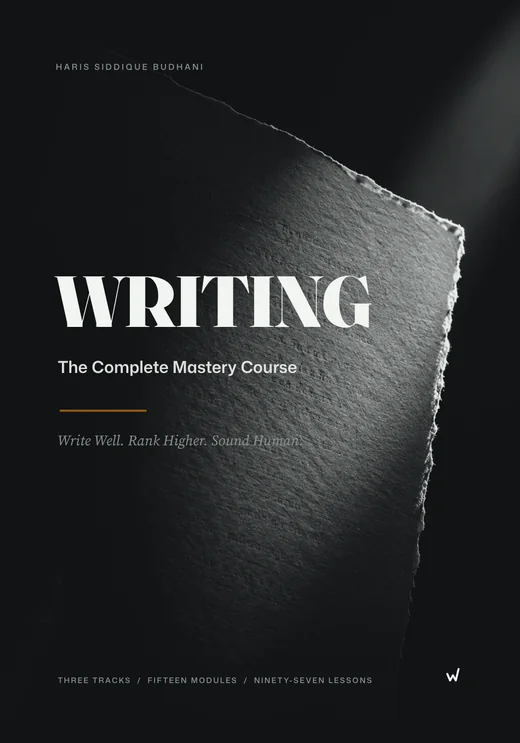
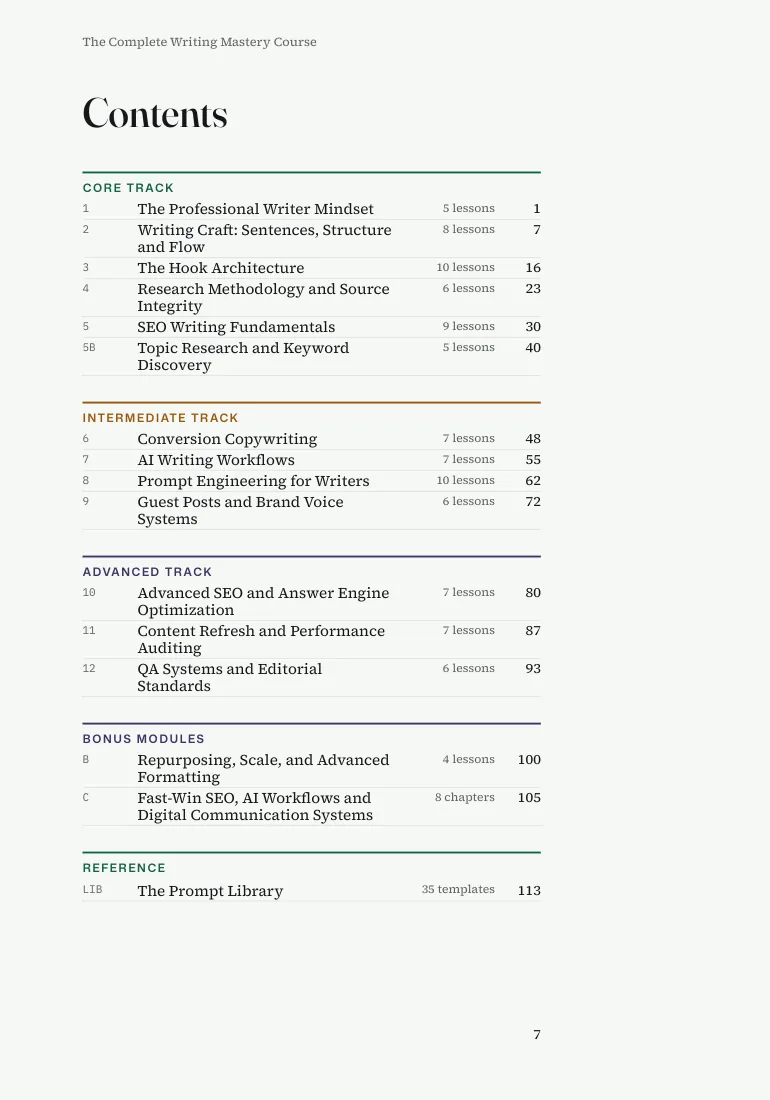
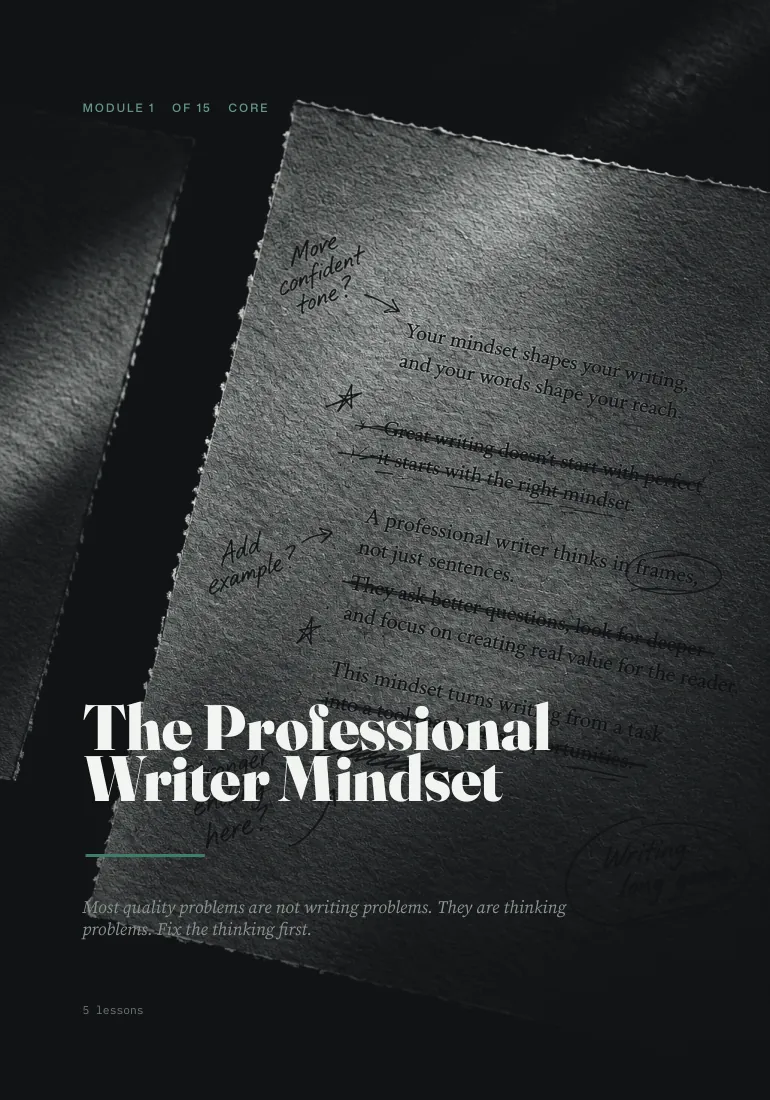
The Complete Writing Mastery Course is an AI writing course in text form: 97 lessons across 15 modules and three tracks, from writing craft and SEO to conversion copy and AI workflows. Each lesson ends in a task, and 35 prompt templates turn the method into drafts you can run today.
- 97 lessons in three tracks, from craft to answer engines
- 35 prompt templates for ChatGPT and Claude, ready to paste
- Module 7, free to read first: the pass that makes AI drafts sound human
- 97
- lessons
- 15
- modules
- 35
- prompt templates
- 139
- pages, PDF and EPUB
Why Writers and Marketers Need an AI Writing Course in 2026
A prompt gives a model instructions. It does not teach you why a draft fails, and that judgment is what separates a draft you publish from one you rewrite.
- AI drafts arrive grammatical and generic, and you can't say what is wrong with them.
- A detector flags your edited draft, and nobody taught you what tripped it.
- Your posts target a keyword but miss the search intent behind it.
- You keep a folder of half-working prompts and no repeatable process.
- Your copy informs well and converts badly, so readers leave without acting.
- AI Overviews answer the question first, and you don't know how to write for that.
The Writing Mastery Course Teaches the Judgment Behind Every Draft
Fifteen modules sit in three tracks: Core, Intermediate and Advanced. Pick the problem you have today to see the module that fixes it and what you do with it.
- Learn one idea per lesson, with worked examples, then do the task at the end.
- Grade your own work with the scoring rubrics on 13 exercises.
- Run 35 prompt templates from the Prompt Library with your own inputs.
- Apply the three-pass edit to every draft, so each pass looks for one thing.
- Finish with a pre-publish QA system that catches what editing misses.
Module 7 · 7 lessons · Intermediate track
My AI drafts sound generic and flat
- What writers need
- A way to spot machine writing and fix it without rewriting from scratch.
- How the course solves it
- Module 7 lists the patterns found in almost every unedited AI draft, then runs a seven-point humanization pass before anything goes out.
- Spot the patterns before a reader or an editor does.
- Run seven checks in order, from the opening to a read-aloud test.
- Learn what AI detectors flag and why a detector score is a poor editing target.
Module 7 · the seven-point humanization pass
POINT 1 Rewrite the opening. If it starts with 'In today's…' or 'In this article…' delete it and start with the claim, a fact, or a contradiction.
POINT 3 Replace vague quantities. For each 'many', 'some' or 'often', use a specific number, a named example, or a real case. If you cannot find one, delete the claim.
POINT 7 Read it out loud. Every place you stumble is a rewrite.
Modules 5 and 5B · 14 lessons · Core track
My posts target keywords but still don't rank
- What writers need
- A way to read search intent before writing, and to find topics in your own Search Console data.
- How the course solves it
- Module 5 covers the four search intent types, reading a results page before you write and E-E-A-T in practice. Module 5B finds keyword opportunities in the Performance tab.
- Read a results page before you write a word.
- Place keywords so they read naturally, in headings that serve readers and crawlers.
- Mine Search Console for new content ideas and build topic clusters.
Module 5 · lessons
LESSONS The Four Search Intent Types. Reading a SERP Before You Write. Keyword Integration That Reads Naturally. Semantic SEO and Topical Completeness. E-E-A-T in Practice. Heading Hierarchy That Serves Readers and Crawlers. Meta Title and Description as Ad Copy. Internal and External Linking.
Module 6 · 7 lessons · Intermediate track
Readers finish my posts and leave
- What writers need
- A way to move a reader toward one action without manipulation.
- How the course solves it
- Module 6 teaches AIDA, PAS and BAB, says which to pick by what the reader already knows, and shows how to write calls to action and handle objections in body copy.
- Choose a framework by reader awareness, not habit.
- Write calls to action that name the next step.
- Answer objections in the copy before the reader raises them.
Module 6 · three conversion frameworks
AIDA Attention, Interest, Desire, Action. Use it when the reader does not know you yet.
PAS Problem, Agitation, Solution. Use it when the reader feels the pain but has not named it.
BAB Before, After, Bridge. Use it when the reader wants a different situation, not a product.
Module 8 · 10 lessons and the Prompt Library · Intermediate track
I have a folder of prompts and no repeatable process
- What writers need
- A repeatable way to turn a topic into a checked draft.
- How the course solves it
- Module 8 teaches the 15-component prompt framework. The Prompt Library adds 35 templates organised by workflow stage, with bracketed inputs you replace.
- Build prompts from fifteen components, not two or three.
- Run templates by stage, from research to editing.
- Flag facts you cannot verify, so you know what to check.
The Prompt Library · how to use it
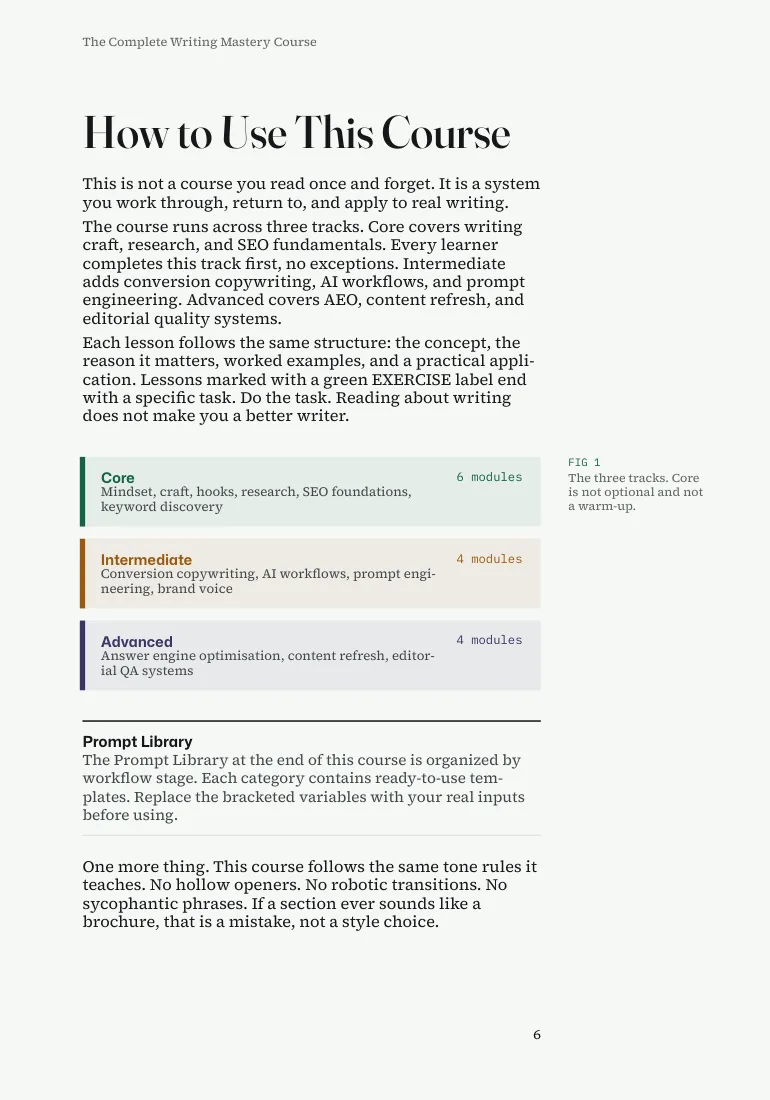
FROM THE BOOK The Prompt Library at the end of this course is organized by workflow stage. Each category contains ready-to-use templates. Replace the bracketed variables with your real inputs before using.
Module 10 · 7 lessons · Advanced track
AI Overviews answer the question before the click
- What writers need
- A way to write pages that an answer engine can quote.
- How the course solves it
- Module 10 covers answer engine optimization: featured snippet types, People Also Ask, writing for AI Overviews, topical authority and schema-ready writing.
- Target the snippet type a query already shows.
- Write passages that stand alone and are easy to lift.
- Use Search Console data to fix titles that lose the click.
Module 10 · lessons
LESSONS What AEO Is and Why It Matters. Featured Snippet Types and How to Target Each. People Also Ask Optimization. Writing for AI Overviews. Topical Authority. Schema-Ready Writing. CTR Optimization Using Search Console Data.
Modules 11 and 12 · 13 lessons · Advanced track
My old posts are losing traffic
- What writers need
- A method to audit what you have and a standard to hold new work to.
- How the course solves it
- Module 11 teaches the five-point content audit and when to refresh or rewrite. Module 12 gives you four checklists for writing standards, SEO, AI and humanization, and sources.
- Audit a post in five points before you touch it.
- Decide between a refresh and a rewrite on evidence.
- Hold every new draft to the same four checklists.
Module 11 · lessons
LESSONS Content Decay: What It Is and Why It Happens. The Five-Point Content Audit. When to Refresh vs. When to Rewrite. Updating Stats, Claims, and Dead Links. Re-Optimizing for Current Search Intent. Adding Semantic Depth to Thin Content. Reading Search Console for Editorial Decisions.
Watch the Machine Leave the Writing
In today's fast-paced digital world, businesses must leverage cutting-edge solutions to unlock their full potential.
Stock opener, vague claims, no specifics. It reads like a machine.
The same line, run through the seven-point humanization pass from Module 7. An illustration, not a detector reading.
Read the pages first
1 / 6
The Writing Mastery Course Method: Five Steps From Lesson to Published Draft
You work through the course the same way every time. Read one short lesson, do its task, score yourself, run a template on real inputs and check the result before you publish.
-
Read a lesson
Each lesson gives the concept, why it matters, worked examples and one practical application.
OUTPUT A concept you can apply to your next paragraph.
-
Do the task
Lessons marked EXERCISE end with a specific task. Do it on a real piece of your own writing.
OUTPUT A finished task, not a note to yourself.
-
Score it
Grade the exercise against its scoring rubric and write down the one thing to fix.
OUTPUT A score and a single fix.
-
Run a template
Pick the Prompt Library template for your workflow stage and replace every bracketed input with your own.
OUTPUT A draft built from your inputs, not generic ones.
-
Check before you publish
Run the Module 12 checklists, then the seven-point humanization pass from Module 7.
OUTPUT A checked piece, ready to publish.
What the Writing Mastery Course Includes
- 139-page PDF and EPUB
- Read on a laptop, phone or e-reader, with lessons short enough to finish before you write.
- 97 lessons in 15 modules
- Three tracks run from mindset and craft to answer engine optimization and editorial QA.
- 13 exercises with scoring rubrics
- Do the task at the end of a lesson, then grade your own work against the rubric.
- 35 prompt templates
- The Prompt Library groups them by workflow stage, with bracketed inputs you replace.
- The Prompt Improver meta-prompt
- Paste a rough prompt in and it rebuilds it with all 15 components. A free guide covers it too.
- The seven-point humanization pass
- Seven ordered checks, from rewriting the opening to a read-aloud test, for every AI-assisted draft.
- Search Console topic research
- Module 5B finds keyword opportunities in the Performance tab and builds topic clusters.
- Conversion frameworks
- AIDA, PAS and BAB, with a rule for choosing by what the reader already knows.
- Answer engine optimization
- Featured snippet types, People Also Ask, writing for AI Overviews and schema-ready writing.
- Content refresh and QA
- The five-point content audit, when to refresh or rewrite, and four checklists for standards, SEO, AI and sources.
- Brand voice systems
- A voice spectrum and a client voice matrix, so you can match a voice that isn't yours.
- Free updates
- Both stores list free updates to the course.
Where to buy, and what each store sells
| Store | Price | Includes |
|---|---|---|
| Whop | $49 | 139-page PDF and EPUB, 35 prompt templates, exercises with scoring rubrics, free updates |
| Gumroad | $49 | 139-page PDF, EPUB and DOCX, 35 prompt templates, exercises with scoring rubrics, free updates |
Prices checked 10 October 2026. Each store shows its own refund terms at checkout.
Why an AI Writing Course Matters Now
Google's guidance on generative AI content says AI can help with research and structure. It also warns that using it to generate many pages without adding value for users may violate Google's spam policies, and it says to factcheck and review AI output manually. That is the gap this course teaches you to close.
Search results changed too. Google says sites that appear in AI Overviews and AI Mode count toward overall search traffic in Search Console. Module 10 teaches you to write passages an answer engine can quote.
And it is a text course. You read, do the exercises and score yourself against the rubrics. There is no video, and it assumes you can already write a sentence. Facts and examples in the book were checked in 2026.
Built From Fifteen Years of Content Work
The author has worked in content and SEO since 2011: building content teams from scratch, training more than 40 writers and auditing hundreds of existing articles, for clients across Pakistan, the MENA region, the UK and North America.
- 15 years
- in content and SEO
- 40+
- writers trained
- 15
- modules and 97 lessons
The industries differ, but the author found the same four problems in almost all of them: wrong intent targeting, weak structure, no humanization system and no QA process. The course addresses all four.
The Writing Mastery Course: Frequently Asked Questions
What is the Complete Writing Mastery Course?
It's an AI writing course in text form: 97 lessons across 15 modules and three tracks, Core, Intermediate and Advanced. It covers writing craft, SEO writing, conversion copywriting, AI workflows and quality checks, with 35 prompt templates and 13 exercises.
Is it a video course?
No. It's a 139-page PDF with an EPUB for phones and e-readers. You read a short lesson, do the exercise at the end and grade your work against the rubric.
Is this AI writing course for marketers?
Yes. It is for marketers, freelance writers and founders who write their own copy. It assumes you can already write a sentence and want writing that ranks, persuades and sounds like you.
Do I need experience with ChatGPT or Claude?
No. Module 8 teaches the 15-component prompt framework from scratch, and the 35 templates in the Prompt Library paste into ChatGPT, Claude or any assistant that accepts a long prompt.
What will I learn about SEO writing?
Search intent, reading a results page, keyword placement that reads naturally, E-E-A-T, headings, internal linking and finding topics in Search Console. Module 10 adds answer engine optimization for AI Overviews and featured snippets.
Will it teach me to beat AI detectors?
No, and it says why. Module 7 covers what detectors such as Originality.ai and GPTZero flag and why a detector score is a poor editing target. Then it gives you the seven-point humanization pass, which fixes the writing itself.
Can I try it before I buy?
Yes. Module 7 is available as a free chapter with three prompts from The Prompt Playbook. The free chapter page links to Whop and Gumroad.
How much does it cost, and where can I buy it?
As of 10 October 2026 it costs $49 on Whop and $49 on Gumroad. The edition table above lists what each store includes.
More questions
What is in each track?
Core has 6 modules on mindset, craft, hooks, research, SEO foundations and keyword discovery. Intermediate has 4 on conversion copywriting, AI workflows, prompt engineering and brand voice. Advanced has 3 on answer engine optimization, content refresh and QA, and two bonus modules follow.
How many lessons are there?
There are 97 lessons: 43 in Core, 30 in Intermediate, 20 in Advanced and 4 in Bonus B. Bonus C adds 8 short chapters on fast-win SEO, outreach and AI search.
What is Module 7 about?
Module 7 covers AI writing workflows: the AI writing stack, what to delegate and what to keep, the patterns found in unedited AI drafts and the seven-point humanization pass.
What are the 35 prompt templates?
The Prompt Library holds 35 templates organised by workflow stage: research, outlines, drafts, editing, SEO, humanization, headlines, copywriting and repurposing, plus the Prompt Improver meta-prompt. Each one has bracketed inputs you replace.
Is this an SEO copywriting course as well?
Yes. Module 6 covers AIDA, PAS and BAB, calls to action and objection handling, and Module 9 covers brand voice systems and guest posts. Bonus C adds a cold email framework.
Is this an SEO content writing course?
Yes. The Core and Advanced tracks teach SEO content writing from search intent to answer engine optimization, and Module 5B teaches topic research with Search Console data.
How is it different from a prompt pack?
A prompt pack gives you inputs. This course teaches why a draft fails, then gives you templates to fix it. The Prompt Playbook is the pack, and it pairs well with the course.
Does the AI writing course include updates?
Yes. Both stores list free updates.
Who wrote the course?
Haris Siddique Budhani, who has worked in content and SEO since 2011, built content teams from scratch and trained more than 40 writers.
Does it cover Search Console?
Yes. Module 5B teaches keyword discovery in the Performance tab, and Module 10 covers CTR optimization with Search Console data.
How do I make AI writing sound human?
Rewrite the opening, delete robotic transitions, replace vague quantities with specifics, break the rhythm, add one human element per section, rewrite the close and read it aloud. That is the seven-point humanization pass in Module 7, and the free chapter shows it on a real draft.
What is answer engine optimization?
It is writing content so AI systems such as ChatGPT, Perplexity and Google's AI features can quote it. Module 10 covers snippet types, People Also Ask and direct, extractable answers, on top of traditional SEO.
Should I buy the course or the Prompt Playbook?
They solve different halves of the same problem. The course teaches the craft that makes content worth reading, and the Playbook supplies the prompts that produce it quickly. The Write & Rank Library bundles both with the Blog Workflow for $69 instead of $100.
Put an AI Writing Course Behind Your Next Draft
Haris Siddique Budhani wrote it from fifteen years of content and SEO work. Start with Module 7 for free, work through the tracks in order, and run your next draft through the seven-point pass. The course is part of the writing and SEO books shelf.
Want the course, the Playbook and the Blog Workflow together? The Write & Rank Library bundles all three.