
The Blog Workflow
Seven prompts for ChatGPT and Claude that run as a chain, so the research happens before the draft.
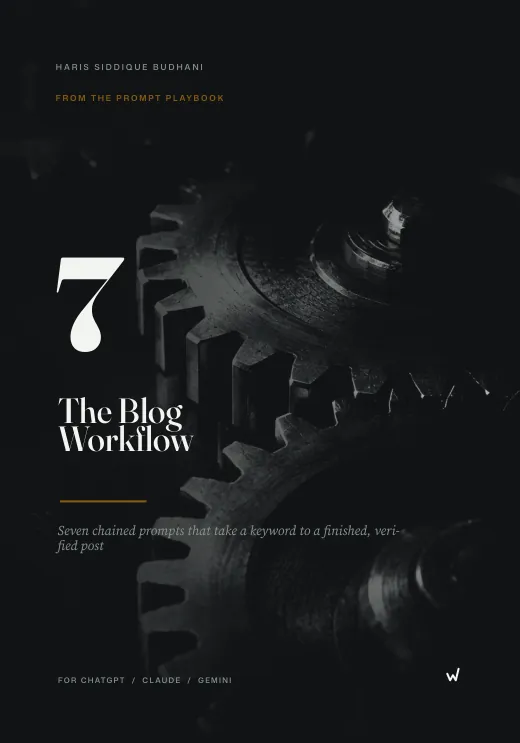
The Blog Workflow is a set of seven SEO blog writing prompts for ChatGPT and Claude that run as a chain: find competitor posts, analyze them, build one heading structure, gather statistics, write the post, summarize it and generate the URL slug. Each prompt uses the output of the one before it.
- Seven prompts that research before they write
- A worked example in a 20-page PDF
- All seven prompts as a plain text file, ready to paste
- 7
- prompts in one chain
- 5
- competitor blogs per run
- 10 to 15
- sourced statistics (B04)
- 20
- pages, PDF
Why Bloggers Need SEO Blog Writing Prompts That Run in Order
One prompt that writes a post from a title gives you copy that reads fine and has nothing to rank with.
- A single prompt writes the post before anyone has checked what already ranks.
- Competitor research happens in your head, if it happens at all.
- The outline repeats the top five posts instead of filling their gaps.
- Statistics arrive without a source, so you can't use them.
- The finished post has no short summary that a snippet can lift.
- The URL slug gets picked in the last minute, and it shows.
The Blog Workflow Is a Chain: Each Prompt Feeds the Next
Run the seven prompts in one conversation, in order. Pick a step to see what it does, what you give it and what comes back.
- Collect five blog posts that already rank, and nothing else.
- Merge their headings into one structure with the gaps filled.
- Pull ten to fifteen current statistics, each with a source link.
- Draft the post against your outline, with keyword density targets set.
- Finish with an 80 to 100 word summary and three URL slug options.
Step 1 of 7 · prompt B01
Find the top five competing blog posts
- What you give it
- Your planned title, the primary keyword, your own domain and any domains to exclude.
- What you get
- Five blog articles for your keyword, each with its URL, title, meta description, a short summary and a note on how it fits your angle.
- Blogs only, never service or home pages.
- Your domain and excluded domains stay out.
- Weak selection here weakens everything after it.
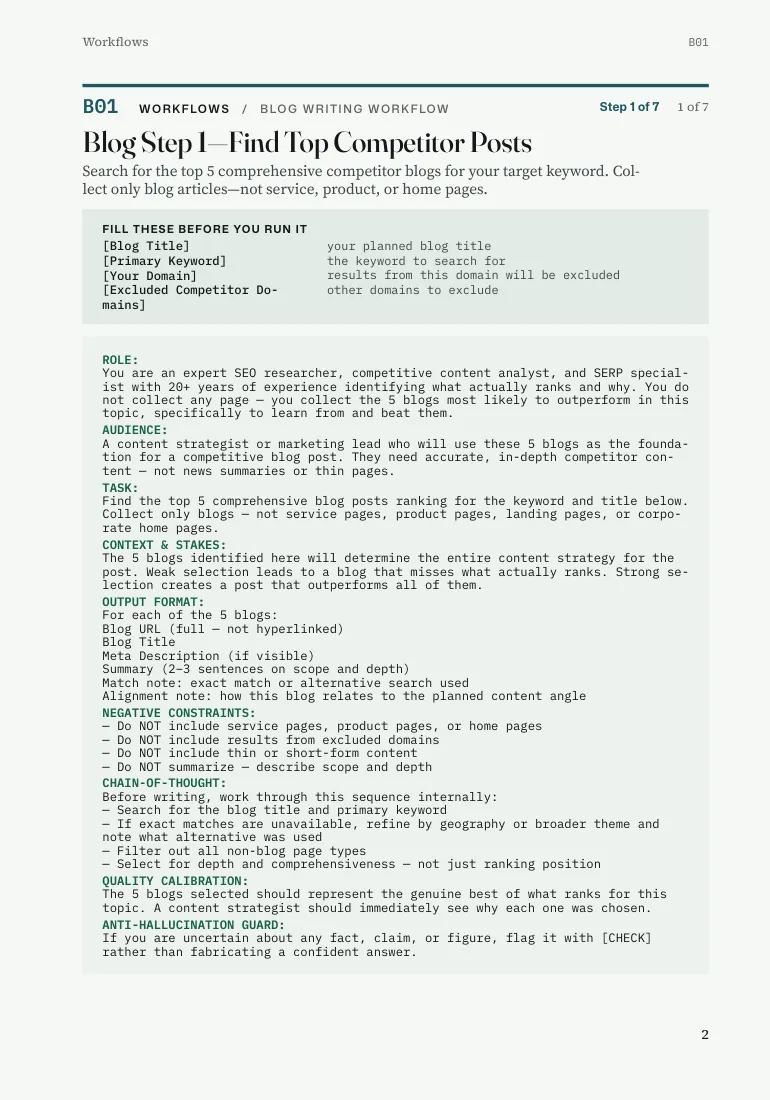
B01 · Blog Step 1
WHAT IT DOES Search for the top 5 competitor blogs for your target keyword. Collect only blog articles, not service, product or home pages.
FILL IN [Blog Title] your planned blog title. [Primary Keyword] the keyword to search for. [Your Domain] results from this domain will be excluded. [Excluded Competitor Domains].
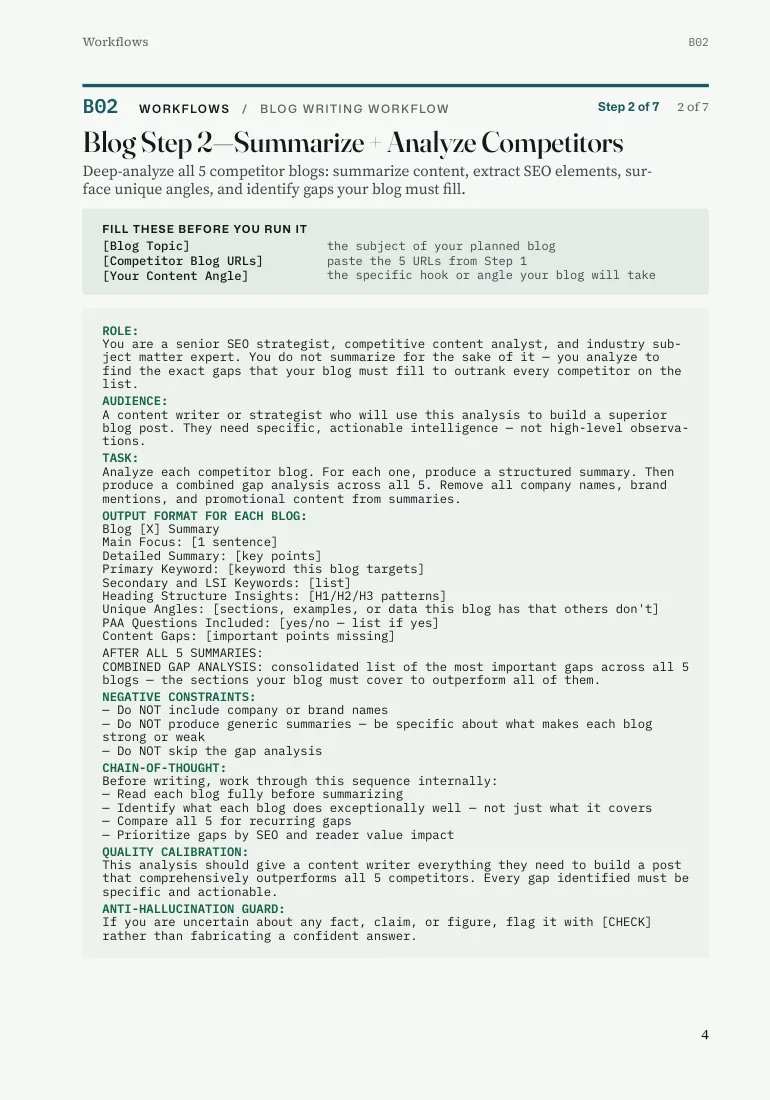
Step 2 of 7 · prompt B02
Summarize and analyze the five posts
- What you give it
- Your blog topic, the five URLs from step 1 and the angle your post will take.
- What you get
- A summary of each post, the keywords it targets, its heading pattern, its unique angles and the gaps your post must fill.
- Each post gets its own summary and keyword list.
- Heading patterns are laid out side by side.
- Gaps become the reason your post exists.
B02 · Blog Step 2
WHAT IT DOES Deep-analyze all 5 competitor blogs: summarize content, extract SEO elements, surface unique angles and identify gaps your blog must fill.
FILL IN [Blog Topic]. [Competitor Blog URLs] paste the 5 URLs from step 1. [Your Content Angle] the hook your blog will take.
Step 3 of 7 · prompt B03
Build a single heading structure
- What you give it
- Your title, the primary and secondary keywords and the heading sets from all five posts.
- What you get
- One clean heading structure with duplicates and off-topic headings removed, the primary keyword in the H1 and at least one H2.
- Duplicates and irrelevant headings drop out.
- Secondary keywords land in H2 and H3 headings.
- You approve the outline before any drafting.
B03 · Blog Step 3
WHAT IT DOES Analyze all competitor headings, remove duplicates and irrelevant entries and produce one clean SEO-optimized heading structure.
FILL IN [Blog Title]. [Primary Keyword] must appear in the H1 and at least one H2. [Secondary Keywords]. [Heading Set 1 to 5].
Step 4 of 7 · prompt B04
Find statistics you can actually cite
- What you give it
- Your topic or title, the primary keyword, your industry, domains to exclude and the type of statistic you need.
- What you get
- Ten to fifteen current statistics from 2023 onward, each with a full source URL, ready to drop into the post.
- Every statistic comes with its source link.
- Competitor domains are excluded.
- You still verify each figure before you publish.
B04 · Blog Step 4
WHAT IT DOES Gather 10 to 15 current, credible statistics (2023 or later) with full source URLs, ready to drop into the blog with no additional research.
FILL IN [Blog Topic or Title]. [Primary Keyword]. [Industry]. [Excluded Domains]. [Stat Types Needed] market size, adoption, ROI, productivity, compliance, cost or all.
Step 5 of 7 · prompt B05
Write the post against the outline
- What you give it
- Your final title, keywords, search intent, funnel stage, content angle and the outputs from steps 1 to 4.
- What you get
- A complete, SEO-optimized, human-sounding blog post built from the outline, the competitor gaps and the sourced statistics.
- Primary keyword density target: 1%.
- Secondary keywords: 0.4% each.
- Related and long-tail terms are woven in where they fit.
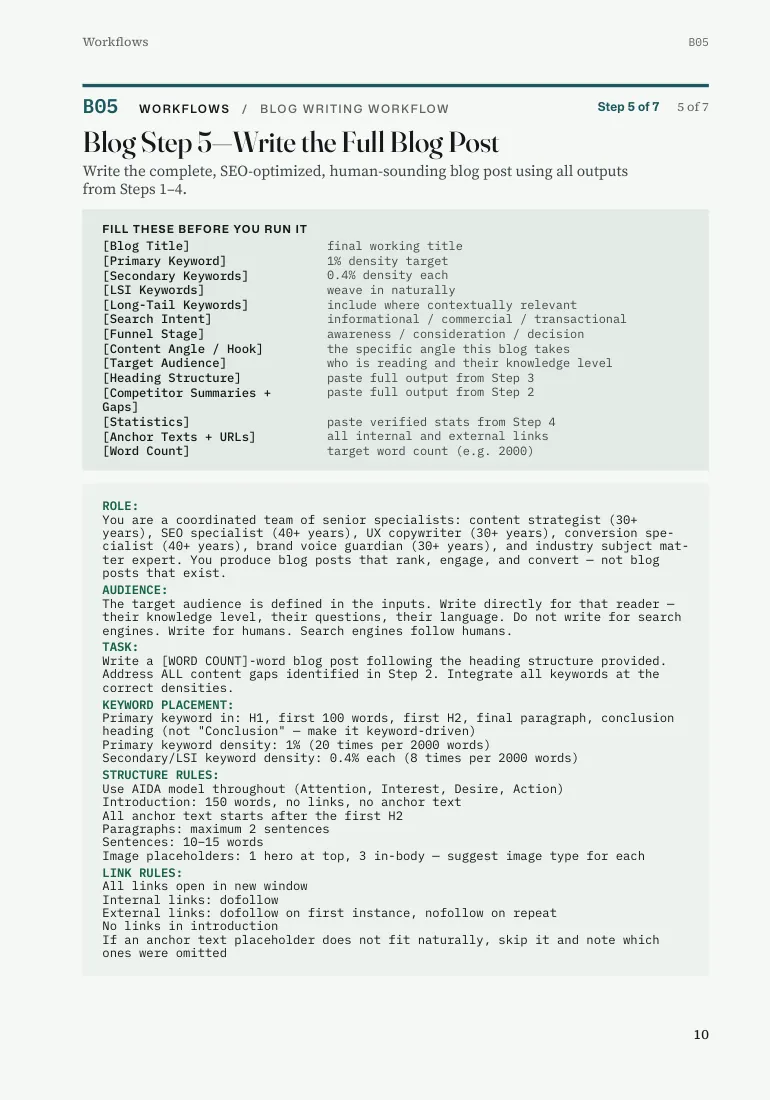
B05 · Blog Step 5
WHAT IT DOES Write the complete, SEO-optimized, human-sounding blog post using all outputs from steps 1 to 4.
FILL IN [Blog Title]. [Primary Keyword] 1% density target. [Secondary Keywords] 0.4% density each. [Search Intent]. [Funnel Stage]. [Content Angle / Hook].
Step 6 of 7 · prompt B06
Write a summary a snippet can lift
- What you give it
- The finished post or its URL, the title, the primary keyword, related keywords, the funnel stage and the audience.
- What you get
- An 80 to 100 word TL;DR that stands alone, puts the primary keyword in the first two sentences and avoids filler openers.
- Between 80 and 100 words, no more and no less.
- Starts with the point, not 'In this article'.
- Useful even if it is the only thing a reader sees.
B06 · Blog Step 6
WHAT IT DOES Generate an 80 to 100 word TL;DR for the finished blog: snippet-ready, keyword-inclusive, action-oriented and valuable on its own.
FILL IN [Blog URL or Full Blog Text]. [Blog Title]. [Primary Keyword] must appear in the first 2 sentences. [Funnel Stage]. [Target Audience].
Step 7 of 7 · prompt B07
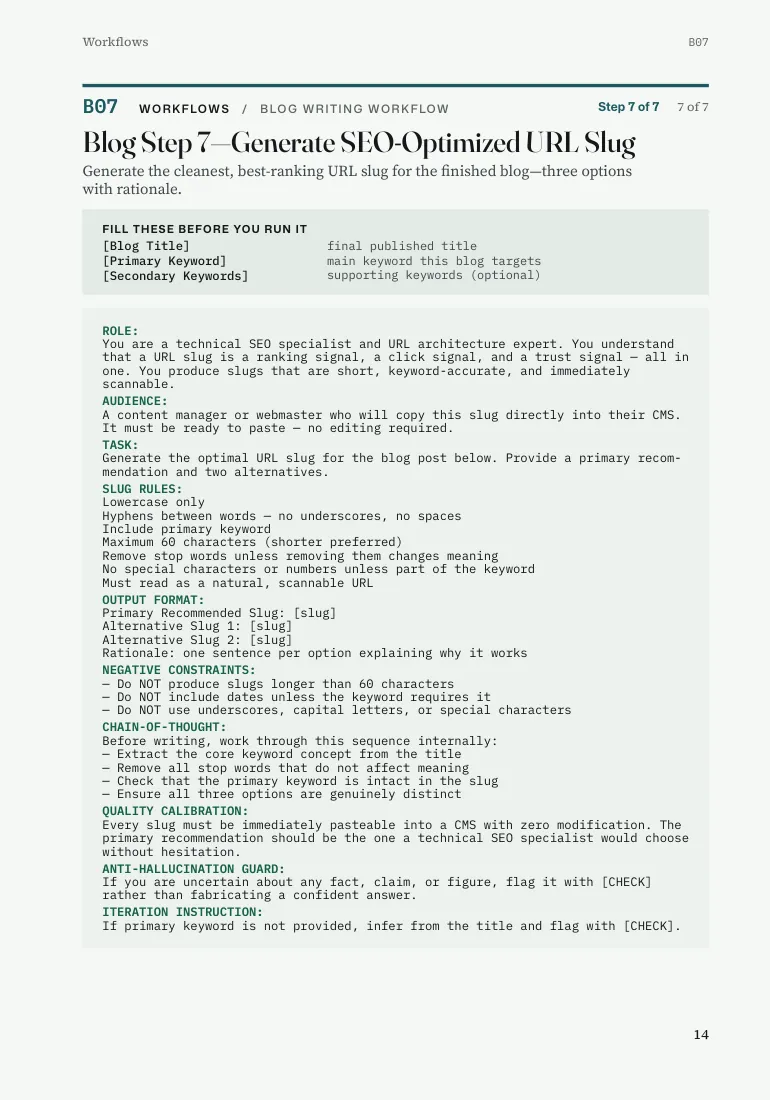
Choose the URL slug on purpose
- What you give it
- Your final title, the primary keyword and any secondary keywords.
- What you get
- One recommended slug and two alternatives, each with a one-sentence reason, none longer than 60 characters.
- Three options, each with a reason.
- No dates unless the keyword needs one.
- Short enough to read in a search result.
B07 · Blog Step 7
WHAT IT DOES Generate the cleanest, best-ranking URL slug for the finished blog: three options with a rationale for each.
FILL IN [Blog Title] final published title. [Primary Keyword]. [Secondary Keywords] optional.
Watch One Topic Become a Finished Post
Scroll through the seven prompts in the order you run them. Each one takes what the one before it produced.
-
B01
Find the top five competing blog posts
You paste in: Your planned title, the primary keyword, your own domain and any domains to exclude.
You get: Five blog articles for your keyword, each with its URL, title, meta description, a short summary and a note on how it fits your angle.
-
B02
Summarize and analyze the five posts
You paste in: Your blog topic, the five URLs from step 1 and the angle your post will take.
You get: A summary of each post, the keywords it targets, its heading pattern, its unique angles and the gaps your post must fill.
-
B03
Build a single heading structure
You paste in: Your title, the primary and secondary keywords and the heading sets from all five posts.
You get: One clean heading structure with duplicates and off-topic headings removed, the primary keyword in the H1 and at least one H2.
-
B04
Find statistics you can actually cite
You paste in: Your topic or title, the primary keyword, your industry, domains to exclude and the type of statistic you need.
You get: Ten to fifteen current statistics from 2023 onward, each with a full source URL, ready to drop into the post.
-
B05
Write the post against the outline
You paste in: Your final title, keywords, search intent, funnel stage, content angle and the outputs from steps 1 to 4.
You get: A complete, SEO-optimized, human-sounding blog post built from the outline, the competitor gaps and the sourced statistics.
-
B06
Write a summary a snippet can lift
You paste in: The finished post or its URL, the title, the primary keyword, related keywords, the funnel stage and the audience.
You get: An 80 to 100 word TL;DR that stands alone, puts the primary keyword in the first two sentences and avoids filler openers.
-
B07
Choose the URL slug on purpose
You paste in: Your final title, the primary keyword and any secondary keywords.
You get: One recommended slug and two alternatives, each with a one-sentence reason, none longer than 60 characters.
Read the pages first
1 / 5
How to Run the Blog Workflow in Five Steps
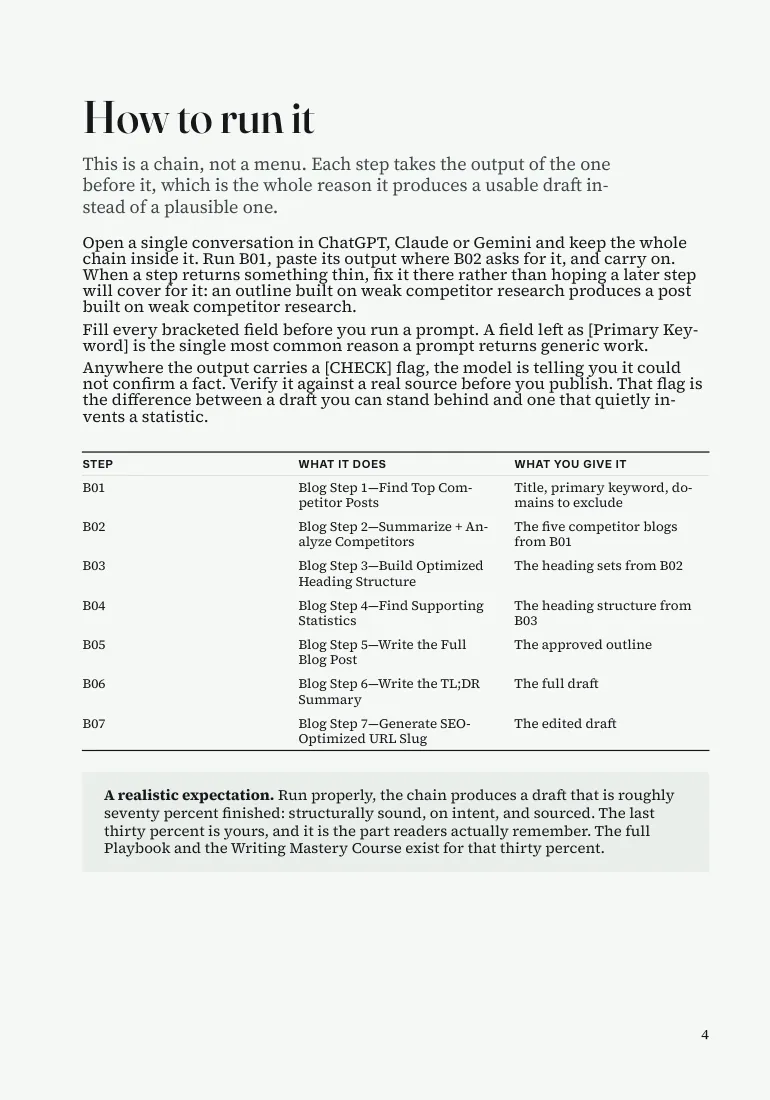
The chain only works if you run it as a chain. Keep it in one conversation, fill every field and fix thin output where it appears.
-
Open one conversation
Start a single chat in ChatGPT, Claude or Gemini and keep the whole chain inside it.
OUTPUT One thread that holds every output.
-
Fill every field
Replace every bracketed field. A field left as [Primary Keyword] is the most common reason a prompt returns generic work.
OUTPUT Prompts with no blanks.
-
Run steps 1 to 4
Run B01 to B04 in order, pasting each output into the next prompt. Fix thin research before you move on.
OUTPUT Competitor research, an outline and sourced statistics.
-
Draft and summarize
Run B05 for the post, then B06 for the summary and B07 for the slug.
OUTPUT A draft, a TL;DR and three slug options.
-
Edit the last thirty percent
Verify every [CHECK] flag against a real source, then edit. The chain gets a draft about seventy percent finished.
OUTPUT A post you can stand behind.
What the Blog Workflow Includes
- A seven-step blog writing workflow
- Seven prompts run as a chain, each taking the output of the one before it, so research comes before writing.
- A 20-page PDF with a worked example
- It shows how to run the chain and what a good result looks like.
- All seven prompts as a plain text file
- Paste a prompt without opening the PDF.
- Competitor research built in
- B01 collects five blogs only and B02 summarizes them and finds the gaps.
- One clean heading structure
- B03 removes duplicates and puts the primary keyword in the H1 and an H2.
- Sourced statistics
- B04 gathers ten to fifteen current statistics from 2023 onward, each with a full source URL.
- Keyword density targets in the draft prompt
- B05 asks for 1% on the primary keyword and 0.4% on each secondary keyword.
- A snippet-ready summary
- B06 writes an 80 to 100 word TL;DR with the primary keyword in the first two sentences.
- Three URL slug options
- B07 gives a recommended slug and two alternatives, each under 60 characters.
- A [CHECK] flag on unverified facts
- Any figure the model cannot confirm is marked, so you know what to verify.
- The same seven prompts also sit inside the Playbook
- The Prompt Playbook holds them as B01 to B07, with 93 other marketing prompts.
Blog Workflow, Prompt Playbook or Write & Rank Library: which one to buy
| Product | Choose it when | Price on Whop |
|---|---|---|
| The Blog Workflow | You want the seven-prompt chain on its own | $12 |
| The Prompt Playbook | You also want 93 other marketing prompts | $39 |
| The Write & Rank Library | You want the course, the Playbook and the chain together | $69 |
Where to buy, and what each store sells
| Store | Price | Includes |
|---|---|---|
| Whop | $12 | 20-page PDF with a worked example, all seven prompts as a plain text file |
| Gumroad | $12 | 20-page PDF with a worked example, all seven prompts as a plain text file |
Prices checked 10 October 2026. Each store shows its own refund terms at checkout.
Can AI-Written Blog Posts Rank? What Google Says
Yes, when they help readers. Google's guidance on generative AI content says AI can help with researching a topic and adding structure to original content. It also says to factcheck and review AI output manually.
The risk is volume without value. Google's spam policies define scaled content abuse as generating many pages for the primary purpose of manipulating search rankings and not helping users, no matter how it's created.
That is why the workflow starts with research and ends with your edit. The chain gets a draft about seventy percent finished, structurally sound, on intent and sourced, and the last thirty percent is yours.
Every Step Names What Goes In and What Comes Out
The first page of the PDF lays the whole chain out in one table: each prompt, what it does and what you give it. Nothing is hidden, so you can judge the workflow before you run it.
- 7
- steps in the chain
- 5
- competitor blogs per run
- 80 to 100
- word TL;DR
A realistic expectation, in the book's own words: run properly, the chain produces a draft that is roughly seventy percent finished. The last thirty percent is yours.
The Blog Workflow: Frequently Asked Questions
What is the Blog Workflow?
It's a set of seven SEO blog writing prompts for ChatGPT and Claude that run as a chain. They find competitor posts, analyze them, build a heading structure, gather statistics, write the post, write a summary and generate the URL slug.
What is a prompt chain?
A prompt chain is a set of prompts where each one takes the output of the one before it. Here the research runs before the writing, so the draft is built on what already ranks.
How to write an SEO blog post with AI using these prompts?
Open one conversation, fill every bracketed field and run B01 to B04 for research, then B05 for the draft and B06 and B07 for the summary and slug. Verify every [CHECK] flag, then edit the last thirty percent yourself.
Can AI-written content rank on Google?
Yes, when it helps readers. Google says generative AI can help with researching a topic and adding structure to original content, and tells publishers to factcheck and review AI output manually.
Does Google penalize AI content?
Google's spam policy targets content generated at scale to manipulate rankings without helping users, no matter how it's created. Using AI to generate many pages without adding value may violate it, so value to the reader is the test.
What is scaled content abuse?
Scaled content abuse is when many pages are generated for the primary purpose of manipulating search rankings and not helping users. Google's spam policies list using generative AI to generate many pages without adding value as an example.
Which AI tools does it work with?
ChatGPT, Claude or Gemini. Keep the whole chain inside one conversation, so each step can use the output of the one before.
How much does it cost, and where can I buy it?
As of 10 October 2026 it costs $12 on Whop and $12 on Gumroad. The edition table above lists what each store includes.
More questions
How is it different from the Prompt Playbook?
The same seven prompts sit inside the Prompt Playbook as B01 to B07. The Blog Workflow sells them alone, with a 20-page guide and a worked example, for people who want the chain and nothing else.
What does each prompt need from me?
Each one lists its fields up front: your title, primary keyword, secondary keywords, search intent, funnel stage and the outputs of earlier steps. Fill every field before you run it.
How does B04 handle statistics?
It gathers ten to fifteen current statistics from 2023 onward, each with a full source URL, and excludes the domains you name. Verify each figure anyway before you publish.
What keyword density does B05 aim for?
The draft prompt sets 1% for the primary keyword and 0.4% for each secondary keyword, and asks the model to weave in related and long-tail terms where they fit.
How long is the TL;DR from B06?
It runs 80 to 100 words and puts the primary keyword in the first two sentences. It avoids openers such as 'In this article'.
What if the research in step 1 or 2 is thin?
Fix it at that step. An outline built on weak competitor research produces a post built on weak competitor research.
Does it write the whole post for me?
It produces a draft about seventy percent finished. It is structurally sound, on intent and sourced, and the last thirty percent is yours.
Which kinds of posts suit it?
Informational and commercial posts where you can name a primary keyword and a search intent. B05 asks for both, plus the funnel stage.
What formats do I get?
A 20-page PDF with a worked example and a plain text file of all seven prompts.
Who wrote the Blog Workflow?
Haris Siddique Budhani, who has worked in content and SEO since 2011, built content teams from scratch and trained more than 40 writers.
Does the chain work in ChatGPT, Claude and Gemini?
Yes. The seven prompts are plain text, and each one asks you to paste the previous output, so the chain runs the same way in any of them.
Put SEO Blog Writing Prompts Behind Your Next Post
Haris Siddique Budhani built the chain around one rule: research first, then write. Pick the keyword for your next post, open one conversation and run B01. The workflow sits on the writing and SEO books shelf.
Want the chain with the course and the Playbook? The Write & Rank Library bundles all three.